

Chapter 3: Drysuits Explained - When a Wetsuit Is Not Enough - Drysuit Scuba Diving
- Akhil Jude

- Apr 22
- 4 min read
Updated: May 9

You can only slow heat loss for so long.
In Chapter 2, we broke down how wetsuits work. They don’t stop heat loss.They slow it down.
That works well in tropical conditions. But there is a limit. There comes a point where slowing heat loss is not enough.
You need to stop it almost entirely. That is where drysuits come in.
The Fundamental Difference in Drysuit Scuba Diving

A wetsuit works by:
Trapping gas inside neoprene
Slowing heat transfer
A drysuit works differently. It removes water from the equation completely.
You stay dry
A layer of gas surrounds your body
Insulation comes from the air and what you wear inside
This is the key shift:
A wetsuit manages heat loss.A drysuit controls your thermal environment.
Why Water Is the Problem
You already know this, but now it matters more than ever:
Water conducts heat 20 to 27 times faster than air
Gas is a very poor conductor of heat
Drysuit scuba diving takes advantage of that. It replaces water contact with a controlled gas layer, dramatically reducing heat loss.
When a Wetsuit Stops Being Enough
Most divers delay this transition too long. You should start thinking about a drysuit when you are:
Diving below 20 to 22°C regularly
Doing long dives
Doing repetitive dives across multiple days
Working as a dive professional in cooler conditions
Traveling to colder destinations
But here is the important part:
It is not just about temperature. It is about exposure over time. A 24°C dive once is fine in a wetsuit. A full day of diving at 24°C is a different story.
How a Drysuit Actually Works
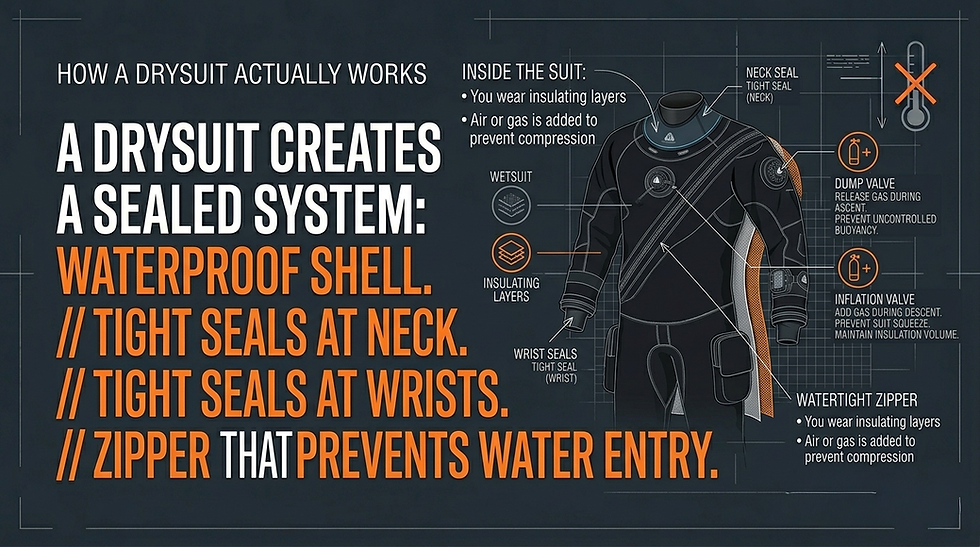
A drysuit creates a sealed system:
Waterproof outer shell
Tight seals at neck and wrists
Zipper that prevents water entry
Inside the suit:
You wear insulating layers
Air or gas is added to prevent compression
Key Components
Inflation Valve
Adds gas into the suit during descent
Prevents suit squeeze
Maintains insulation volume
Dump Valve
Releases gas during ascent
Prevents uncontrolled buoyancy
This means your suit is no longer passive. It becomes part of your buoyancy system.
Types of Drysuits (And What Actually Matters)
Neoprene Drysuits for Scuba Diving
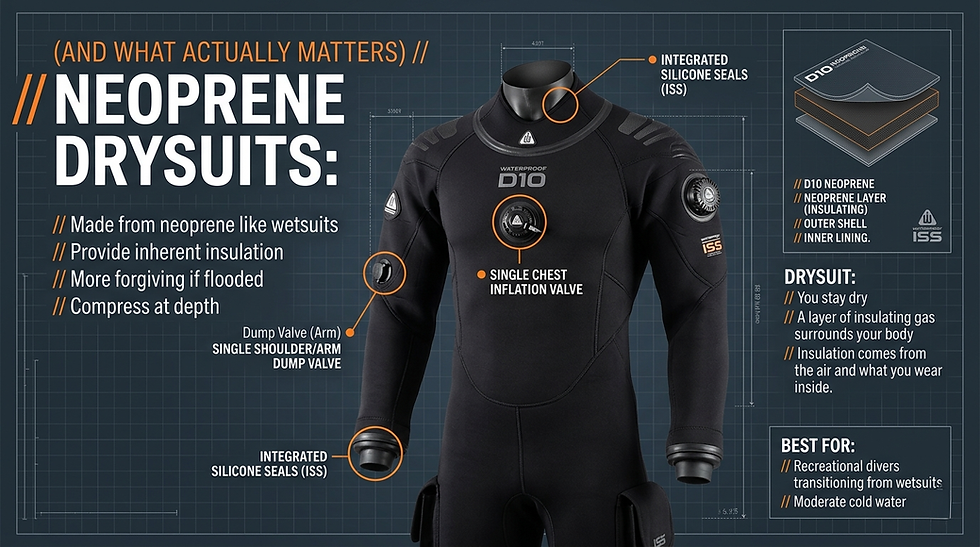
Made from neoprene like wetsuits
Provide some inherent insulation
More forgiving if flooded
Compress at depth
Best for:
Recreational divers transitioning from wetsuits
Moderate cold water
Membrane (Trilaminate) Drysuits for Scuba Diving

Thin outer shell with no inherent insulation
Insulation comes entirely from undersuits
Do not compress with depth
Advantages:
Consistent performance at all depths
More flexible layering options
Lighter and faster drying
Best for:
Serious divers
Cold water diving
Technical diving
Compressed Neoprene Drysuits for Scuba Diving
Pre-compressed neoprene
Less buoyancy change than standard neoprene
More stable at depth
A hybrid between both worlds.
The Most Important Part: What You Wear Inside

This is where many divers get it wrong.
With a wetsuit, insulation is fixed. With a drysuit, insulation is customizable. Your warmth depends on your undersuit system.
Common options:
Fleece for general use
Thinsulate for colder conditions
Moisture-wicking base layers to stay dry
This allows you to:
Adjust for different temperatures
Stay comfortable across long dives
Maintain consistent insulation
Why Drysuits Solve the Depth Problem
In Chapter 2, we discussed neoprene compression.
That problem disappears with drysuits.
The gas layer inside the suit can be maintained
Insulation does not collapse at depth
Thermal performance remains stable
This is one of the biggest advantages. You are no longer losing insulation as you descend.
But There Is a Trade-Off
Drysuits are not just “warmer wetsuits.” They come with complexity.
You must manage:
Buoyancy inside the suit
Gas expansion during ascent
Proper weighting
This is why: Drysuit certification is essential.
Without training, a drysuit can:
Increase risk
Complicate ascents
Create buoyancy issues
Common Mistakes Divers Make
Waiting too long to upgrade
They tolerate discomfort instead of solving the problem.
Underestimating layering
A drysuit is only as good as what you wear inside.
Ignoring training
Trying to “figure it out” without certification is risky.
Overheating before the dive
Drysuits trap heat extremely well on land.
Who Should Seriously Consider a Drysuit
Divers traveling to colder regions
Technical divers
Professional divers working long hours
Divers who feel cold easily
Anyone doing extended bottom times
Drysuit vs Wetsuit: The Real Decision
It is not about which is better. It is about what problem you are solving.
Choose a wetsuit if:
You are diving warm water
Exposure times are moderate
You want simplicity
Choose a drysuit if:
You need thermal stability over long durations
You are diving cold or variable conditions
You want full control over insulation
This Is Not About Comfort Anymore
At this level, thermal protection becomes operational.
A drysuit:
Extends your dive time
Reduces fatigue
Improves focus
Increases safety margins
It allows you to function, not just tolerate the environment.
Coming Next: Beyond Wetsuits and Drysuits
Thermal protection is evolving.
In the next chapter, we explore:
Sharkskin and advanced thermal systems
Layering strategies
When traditional suits are not enough
Get Your Setup Right Before You Need It
Most divers think about drysuits too late. By the time you feel the need, you have already been underperforming.
If you are planning:
Cold water dives
Travel
Extended diving
Get your system sorted in advance.
Talk to Proscuba and build a thermal setup that works in real conditions, not just ideal ones.


Comments